
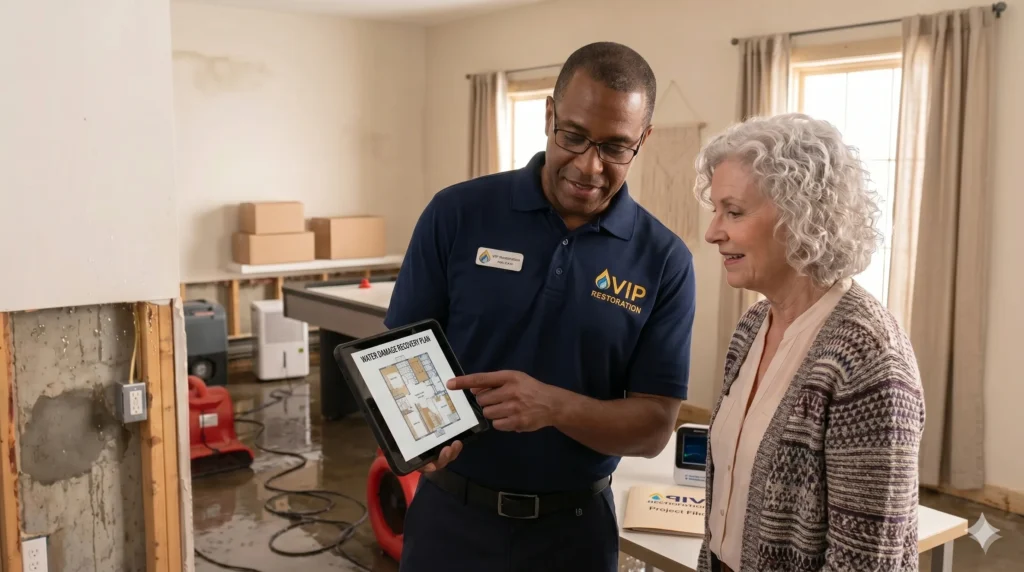
Homeowners in Virginia often ask about how much does water restoration cost today?
The short answer is you need between $1,500 and $5,000 for professional recovery services.
VIP Restoration provides immediate relief through extraction and drying to preserve your property value and your family’s safety.
Key Takeaways
- Time represents money because mitigation expenses climb every hour fluid touches porous subflooring materials.
- Various classifications dictate total prices based on volume and the cleanliness of that source.
- Alexandria insurance policies handle sudden accidental discharges but ignore damages from slow-leak negligence.
- Expert moisture extraction within forty-eight hours prevents secondary three-thousand-dollar mold remediation bills effectively.
How Do Immediate Responses Control Total Expenses?
Rapid initial action serves as the main variable for limiting flood-related financial burdens. Moisture travels through drywalls and structural timbers within minutes to cause permanent cellular breakdown. High-capacity pumps prevent dampness from wicking into wall envelopes when experts deploy them early. Aggressive intervention halts damage progression before the situation necessitates complete structural demolition.
Crucial Steps for Mitigation
- Emergency Extraction: Truck-mounted vacuums remove bulk liquids from carpets or hard surfaces.
- Stabilization: Industrial dehumidifiers drop relative humidity below forty percent to stop secondary destruction.
- Scientific Monitoring: Moisture meters track specific dry goals until the building reaches equilibrium.
- Final Sanitization: EPA-registered antimicrobials eliminate pathogens that moisture leaves behind.
What Are the Primary Factors Influencing Cleanup Prices?
Restoration invoices reflect technical challenges present in a property layout or damage level. Technicians within the state must calculate local disposal fees and current market rates for medical-grade insulation. Affected square footage and cramped crawlspace accessibility dictate the total labor hours required.
Risk Mitigation
High toxicity levels necessitate specialized personal protective equipment plus specific disposal protocols. Deeply embedded wetness within concrete or hardwood requires additional time for complete extraction.
Technical Execution
Air volume processing depends on the specific density of required LGR dehumidifiers. Industrial fans run constantly and add a necessary marginal expense to the project.
How Much Does Water Restoration Cost Based on Water Type?
Experts categorize fluids into three tiers to establish safety protocols and project budgets. Clean spills from supply lines are most affordable because they need less aggressive chemical treatment. Predicting how much does water restoration cost gets complicated with Category 3 sewage backups. These biohazards demand rigorous disinfection plus the total removal of impacted building materials.
Water Quality Price Comparison
| Water Category | Source Example | Mitigation Difficulty | Comparative Price |
| Category 1 (Clean) | Broken Pipe / Sink Overflow | Low – Dry in place | Base Rate |
| Category 2 (Gray) | Dishwasher / Washing Machine | Moderate – Chemical wash | +25-40% |
| Category 3 (Black) | Sewage / River Flooding | High – Full biohazard PPE | +70-100% |
How Do Restoration Classes Impact the Total Project Price?
Restoration categories measure anticipated evaporation rates and the difficulty of moisture removal. Class 1 events involve minimal dampness in local areas needing few air movers. Conversely, Class 4 situations with low-porosity stones or hardwoods require advanced pressure systems. Such technologies reach deep-seated wetness but carry higher daily rental rates.
- LGR Dehumidification: Low Grain Refrigerant units pull humidity from air during cool local winters.
- Centrifugal Air Movers: High-velocity fans break the boundary layer of air on wet surfaces.
- HEPA Air Scrubbers: Filtration systems remove nearly all airborne particles throughout the dry process.
- Intraset Drying: This technique injects warm air directly into wall cavities to save studs.
How Does Structural Damage Affect Material Replacement Needs?
Specific building materials act like sponges and lose structural integrity immediately upon saturation. Experts prioritize the preservation of home framing while disposing of carpet padding or laminate. Specialists execute flood cuts into drywall twelve inches above lines to dry insulation. Component replacement increases the bill but guarantees long-term indoor health for inhabitants.
What Is the Role of Professional Assessment and Documentation?
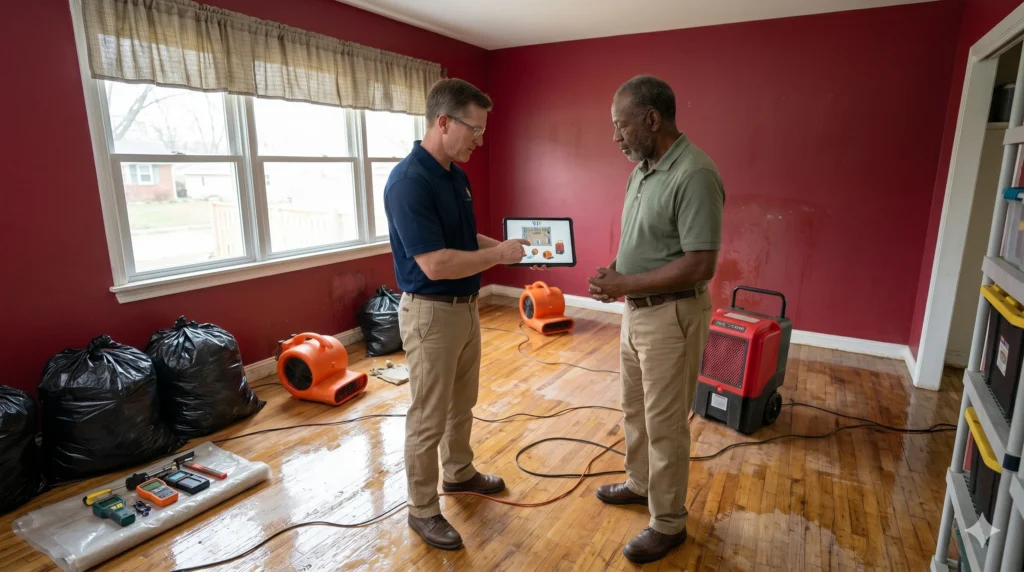
Technical assessments serve as recovery roadmaps and primary evidence for insurance claims. Professionals employ science to map where wetness migrated so no Alexandria property corner stays overlooked. This documentation provides transparency for performed work while justifying the use of specific equipment.
- Moisture Mapping: Infrared technology visualizes the exact footprint of a recent flood.
- Psychrometric Logs: Daily temperature and humidity readings prove the actual drying progress.
- Inventory Loss: Detailed photo evidence of ruined furniture assists with reimbursement requests.
Expert Perspective
Pro Tip: Avoid turning on central HVAC systems after significant floods occur. Water inside floor vents or ductwork risks spreading mold spores throughout your house. Keep systems inactive until professionals inspect internal trunk lines for dampness.
Get the Best Water Restoration at a Reasonable Price
Recovery requires a balance of physical action and precise technical documentation. When homeowners evaluate how much does water restoration cost for local properties, inaction remains the priciest choice. Our team stays ready day and night to deploy industrial technology plus certified expertise. VIP Restoration Services manage heavy lifting and insurance paperwork so you focus on returning home.
Start your journey toward a dry residence today. Call VIP Restoration at 240-370-6634 for a professional assessment right now.
Frequently Asked Questions
Q: Does insurance cover the full cost of water restoration?
A: Most homeowner policies cover restoration expenses for sudden events like pipe bursts. You usually pay the policy deductible while carriers handle professional mitigation balances.
Q: How long does the professional drying process usually take?
A: Standard drying projects in Virginia require three to five days of continuous equipment operation. Technicians monitor moisture levels daily to ensure materials meet regional dry standards.
Q: Can I stay in my home during the restoration?
A: Residents often remain if damage stays isolated to one room or basement. Significant sewage backups or Category 3 floods require temporary relocation for safety.
Q: Will my hardwood floors need to be replaced?
A: Our specialists often save high-value hardwoods using specialized floor mats and powerful vacuums. Prompt action serves as the deciding factor for preventing permanent wood warping.
Q: What is the difference between restoration and remediation?
A: Restoration involves the process of drying structures and repairing physical damage. Remediation specifically describes the removal of hazardous biological growth like mold or bacteria.

