
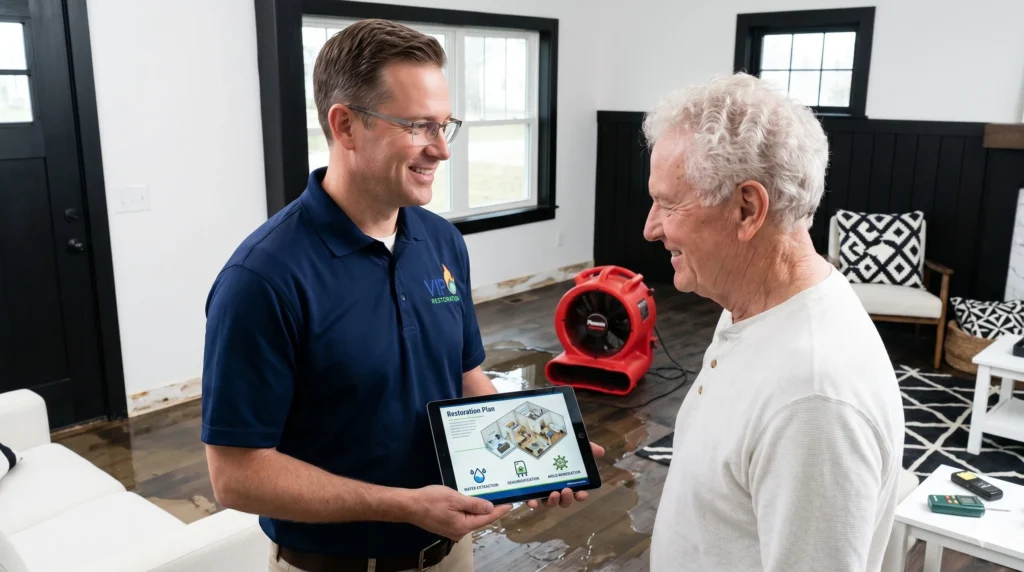
You’ve got a flood. Maybe a pipe burst or the rain breached the slab. You need water damage restoration to save your equity. With VIP Restoration Services, homeowners get the expertise needed to navigate every stage of the recovery process. But first, you have to understand the two-step dance of recovery.
Most homeowners mix up mitigation and restoration. That’s a mistake that costs thousands. Mitigation stops the bleeding. Restoration fixes the scars. You need both to keep your home from rotting out from the inside. VIP Restoration Services helps ensure that each phase is completed correctly, protecting your property from long-term damage.
Key Takeaways
- Halt the spread by stopping water migration instantly.
- Rebuild the space only after the studs hit dry standards.
- Execute a total plan to satisfy insurance adjusters.
- Act fast to kill the 24-hour mold clock.
- Get a pro tech to map the hidden moisture.
What Is Water Damage Restoration and What Does It Include?
Restoration is the “make-back.” It’s the craftsmanship that turns a disaster zone into a home again. This isn’t just about sucking up puddles. We are rebuilding your life. This phase starts when the fans turn off. It involves heavy trade work. We replace what the water killed.
A full-scale water damage restoration usually involves this grit:
- Replace the mushy drywall and soaked R-13 insulation.
- Sanitize the slab with professional antimicrobial agents.
- Install new flooring to match your interior.
- Purge odors using high-output hydroxyl generators.
- Paint the finish to erase every trace of the flood.
It’s about making things right. It’s the final step in the recovery chain.
What Is Water Mitigation and How Is It Different?
Mitigation is the ER visit. It happens while the water is still moving. The goal is simple: stop the damage from getting worse. We don’t worry about aesthetics here. We worry about physics. We pull the water out before it wicks up the studs.
Mitigation looks like this:
- Vacuum bulk water from carpets and pads.
- Seal the room to control the local climate.
- Tarp the roof if the storms break through.
- Monitor moisture levels with thermal imaging.
Mitigation stops the rot. Restoration follows to fix the holes we left behind.
Water Damage Restoration vs Water Mitigation: Key Differences
One stops the clock. The other resets it. Most outfits do both, but the billing is different. You need to know the split. Mitigation is the emergency. Water damage restoration is the reconstruction.
Water mitigation addresses the emergency. Water damage restoration addresses the recovery. Below is a direct comparison to help illustrate the differences:
| Category | Water Mitigation | Water Damage Restoration |
| Primary Goal | Prevent further damage | Restore property to pre-loss condition |
| Timing | Immediately after a water event | After mitigation is complete |
| Focus | Water removal and stabilization | Repair, rebuild, and sanitize |
| Equipment Used | Pumps, extractors, air movers | Dehumidifiers, reconstruction tools |
| Mold Prevention | Reduces risk | Removes existing mold if present |
| Structural Repairs | Not typically included | Included if materials are damaged |
| Insurance Role | Documents initial damage | Supports full repair claim |
Which Service Do Homeowners Usually Need?
Usually, you need the full package. If water touches drywall, it’s a restoration job. If it’s standing on the floor, it’s a mitigation job. You rarely get one without the other.
Example:
- A flooded basement needs extraction (Mitigation).
- The saturated baseboards need a total swap (Restoration).
- Warped hardwoods need a sand-and-finish (Restoration).
- Wet crawlspaces need immediate airflow (Mitigation).
If you skip the rebuild, the house is a shell. If you skip the dry-out, you’re building on top of a swamp.
How Does Timing Affect the Outcome?
Time is the enemy. Water is a solvent. It eats your house.
The first 24 hours:
- Drywall wicks moisture up three feet.
- Furniture stains become permanent.
- The humidity starts the bacterial bloom.
The 48-hour mark:
- Black mold starts its growth cycle.
- Wood subfloors begin to swell and buckle.
- The smell becomes a health hazard.
Fast mitigation makes the restoration cheaper. Wait too long, and you’re gutting the whole floor.
Is One More Expensive Than the Other?
Mitigation is cheaper upfront. It’s just labor and gear. But if you blow off the mitigation, the restoration bill explodes. You’ll pay for mold crews and structural repairs that weren’t necessary on day one.
Delaying the call causes:
- Total gut jobs of the electrical system.
- Structural rot in the load-bearing plates.
- Full replacement of hardwood instead of drying.
Call the pros early. Save your bank account later.
Can You Skip Mitigation and Go Straight to Restoration?
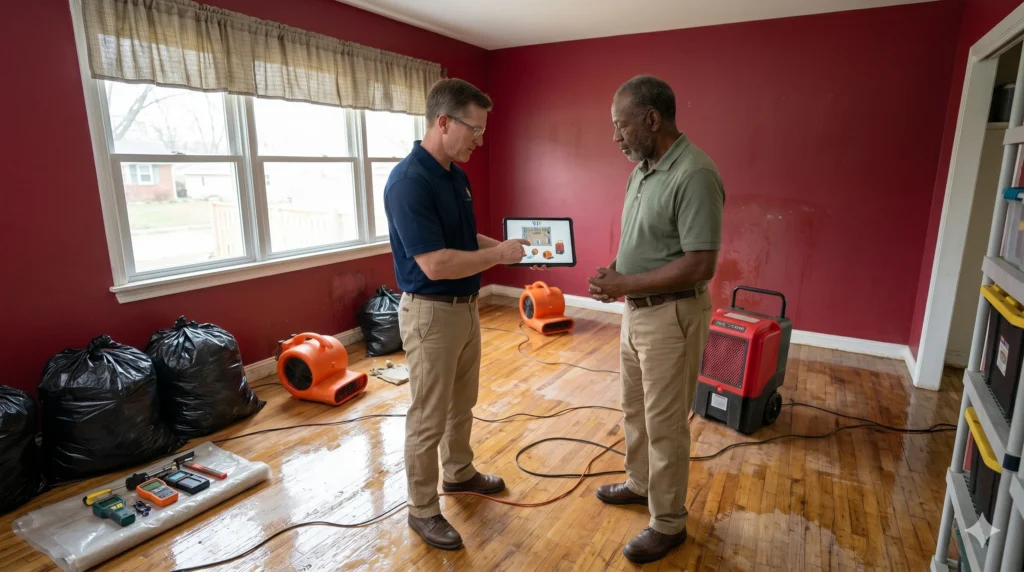
No. That’s a recipe for a “mold house.” If you hang new drywall over wet studs, you’re trapping a colony. The wood will twist. The paint will bubble. The smell will never leave.
Shortcutting the dry-out leads to:
- Hidden mold behind the new cabinets.
- Warped framing that cracks your new tile.
- Failed inspections when you try to sell.
We check the wood with meters. If it’s not dry, we don’t build.
Conclusion
Stop the water first. Fix the damage second. Mitigation buys you time. A professional water damage restoration service gives you your home back. It’s a specialized trade that requires the right gear and the right grit.
Don’t let a leak turn into a knockdown. If you’re dealing with a mess, get tech on-site now. VIP Restoration Services will handle the dry-out and the rebuild from start to finish, helping protect your property from long-term damage. Call VIP Restoration Services today at (240) 370-6634 for a professional water damage restoration quote and fast emergency response.
Frequently Asked Questions
Q: Are mitigation and restoration done by the same company?
A: Most of the time, yes. One crew, one point of contact. It makes the insurance claim move way faster. It keeps the guys accountable from start to finish.
Q: How long does the entire process usually take?
A: The dry-out is usually three days. The rebuild can take a week or a month. It depends on the materials and the supply chain.
Q: Does insurance cover both mitigation and restoration?
A: If it’s an accident, yes. Your policy is designed for this. We document every fan and every foot of drywall to make sure they pay out.
Q: What happens if only mitigation is performed?
A: You’ll have a dry house that looks like a war zone. The studs will be bare. The floors will be concrete. You need the finished work to regain your value.
Q: Is restoration necessary for small water incidents?
A: If it hit the wall, yes. Even a small leak can rot the sill plate. Don’t guess. Get a moisture reading before you close the door on it.

